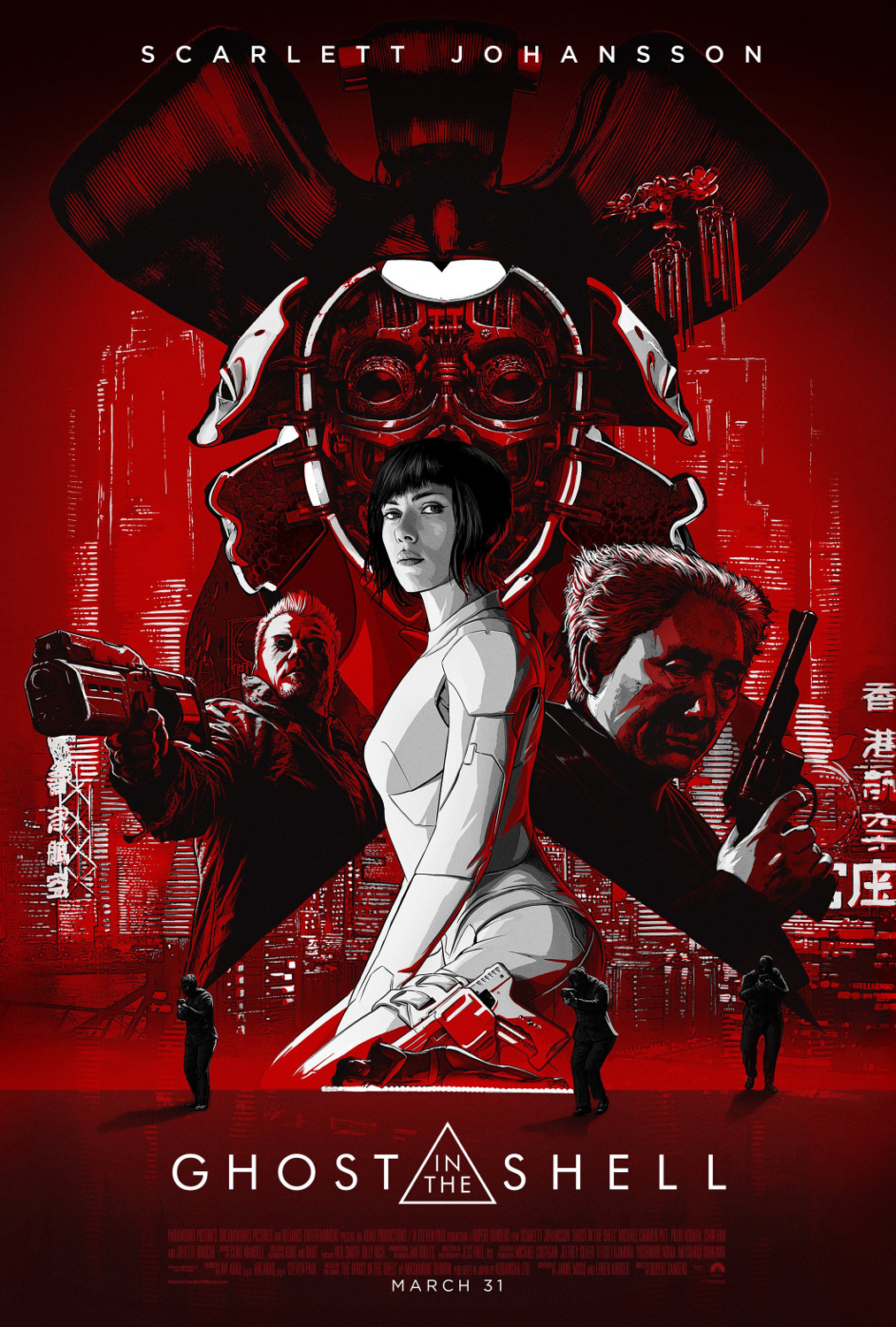
Release Date: March 30th, 2017 (AUS)
Genre: Sci-Fi, Action
Director: Rupert Sanders
Writers: Jamie Moss, William Wheeler, Ehren Kruger
Cast: Scarlett Johansson, Michael Pitt, Pilou Asbæk,
Juliette Binoche, Takeshi Kitano
Plot: Major Mira is an officer of Section 9, an
anti-cyberterrorism branch of the police force. She is also a
cybernetically-enhanced soldier, having lost her human body in a terrorist
attack a year prior. When Section 9 investigates a series of attacks that left
the victims with their “ghosts” wiped clean by a mysterious hacker known as
Kuze, Mira becomes embroiled in a mass conspiracy that will leave her
questioning just how ‘human’ she is in the wake of her upgrade.

Acting: Scarlett Johansson is great as the Major, nailing
personal strength with a dry sense of humour that makes for an engaging
presence on screen. Probably helps that, between her work in the Marvel
Cinematic Universe and Lucy, she can sell the action scenes like the best of
them. Pilou Asbæk as Batou, putting aside that the version of the character
from Stand Alone Complex is one of my all-time favourite anime characters,
honestly lives up to the personable and caring personality that has stuck with
through most iterations of the franchise. He also has remarkable chemistry next
to Johansson, resulting in the kind of double-act that the next several months
worth of cinematic team-ups will have to live up to. Michael Pitt as the
initial antagonist Kuze hits menace and sympathy in appropriate proportions,
and his scenes next to the Major make for the most emotionally powerful moments
of the film. Then there’s Beat Takeshi, a man whose filmography is as prolific
as the man himself, considering how he has managed to do pretty much everything within his lifetime. His turn
as the leader of Section 9, even considering how little screen time he
ultimately gets, is very effective and when he gets given moments of badassery,
he pulls them off superbly.

Positives: Considering director Rupert Sanders’ only other
film to his name was the utterly underwhelming Snow White And The Huntsman, he
definitely nailed the cyberpunk aesthetic here with how immense and alienating
Neo-Tokyo looks with its looming holographic advertisements and overshadowing buildings.
The action scenes are very lively and very flashy while also showing where the
Wachowskis got a lot of their tricks from, considering the original Ghost In
The Shell film was one of their key influences for The Matrix. At the same
time, while it doesn’t shy away from their mutual predecessor, it also doesn’t
make it a point to look incredibly derivative in the process. To accompany
this, we have composer Clint Mansell, better known for his work for Darren
Aronofsky, who likewise pays tribute to the original series while keeping
things fresh. Along with
LEGO Batman Movie composer Lorne Balfe, they create an
appropriately glitchy and eerily beautiful texture to the film.

Through the varying tonal approaches the franchise has gone
through in its many incarnations, from the dead-serious 1995 film to the more
upbeat series Stand Alone Complex and everything in-between, some thematic
elements have stayed consistent throughout. And honestly, going by what I
understand concerning Ghost In The Shell as a whole (no doubt, I will be
heavily corrected on all this because God forbid someone have a different
interpretation of a work of fiction, this feels right in relation to the core
elements of the story of the Major and Section 9. Personal identity, the
objectification of women, the line between man and machine and the implications
of where that line may be, even the increasing ubiquity of technology itself in
modern society; this film manages to weave its way through these notions and,
while giving them suitable breathing room within the narrative, allow them to
accompany the story rather than the force pushing the characters from scene to
scene. This does result in a couple of moments where the philosophical
undertones are spelled out a little too
clearly for the audience, but overall, it checks out. Given how the imbalanced
nature of the subtext as opposed to the actual text has always been an issue
with GitS media, it’s quite remarkable how well this film does in that regard.
Especially considering this was co-written by Ehren Kruger, the guy responsible
for some of the absolute worst moments in the already woeful Transformers
films.
Then there’s the initial controversy that sprang up
concerning the casting of Johansson in the lead role, resulting in a lot of
decrying of whitewashing and other such uncomfortable issues. Just to be clear,
my own stance on this issue is that of general apathy: The instances that
usually get brought up nowadays concerning whitewash casting, nine times out of
ten, are a result of kneejerk reaction and a general unwillingness to look
beneath the surface to show that, no, regular whitewashing rules don’t apply.
Now, with that said, I specify “nine times out of ten” because the practice is
decried for a reason: White saviour narratives are unfortunately prevalent and,
like with what happened with Pan back in 2015, it often shows how little real
progression has been made when it comes to racial representation in Hollywood.
I bring all this up because, much like
The Great Wall earlier this year, I
genuinely feel like the outrage here is unwarranted and largely missing the
point. Along with how culturally diverse the cast here is overall, up to having
mostly Japanese actors depicting characters who haven’t gotten on the
artificial enhancement bandwagon, whitewashing as a practice is actually part
of the plot itself to a certain degree. What’s more, it’s depicted very much as
a negative thing, playing into the questions of how much of our natural
humanity could be lost in the face of technologising our lives to this extent.
But the thing is that, even if the controversy held water when talking about
the full-length production rather than just the marketing material, it
inexorably brings up questions about personal and cultural identity. At its
core, that’s what the series is all about so, whether you agree with its
directions or not, it still leads to a rather integral part of the series’
mythos.
Conclusion: Continuing what I can only assume is the 2017
tradition of crushing preconceptions of art under foot, this is actually really
damn good. Strong acting, incredible visuals, effective fight scenes and
setpieces and an understanding of the source material and its main themes that
even some of the Japanese iterations fumbled with. There’s also a certain joy I
find in a film that it could be argued has failings… and yet, no matter what
your stance on them, those failings end up building on the film’s own themes
and adding to its strengths.