I wasn’t
expecting to like this. Knowing how badly my palette rejected the textures of
Adam McKay’s Don’t Look Up, seeing him produce more satire didn’t exactly put
my stomach at ease. But I am nothing if not open to new flavour combinations and
experiences, so I tucked in with this one, and I have to admit, I quite like
what I was served. “I wonder if constantly comparing films to food will ever
get annoying to readers?”, said no critic ever, apparently.
This is as
much a critique of the world of haute cuisine as it is of the ways in which the
people engage with it, whether it’s through being in the restaurants themselves
or experiencing them through some kind of proxy, be it a critic’s opinion of it
or it being filmed for television. David Gelb, creator of the Netflix series
Chef’s Table, does the second unit work here and he brings a lot of familiar
techniques to the production, right down to the way each course in the titular
Menu is presented, complete with ingredient list. Said courses, recreated from
the Michelin star menu of Dominique Crenn’s Atelier Crenn in San Francisco, are
as enticing to look at as they are ridiculously ostentatious, especially when
hearing the servers and guests describe them.
Much like
with Flux Gourmet, another film about turning what we digest into some form
of sophisticated art, part of me feels targeted specifically by what’s being
said here. I mean, I’ve made it my lot in life to wax poetic about the nature
of art and the ways it can affect an audience; seeing a server describe a wine
as having notes of longing and regret felt like something I might’ve written
unironically at one point. But also like with Flux Gourmet, the art in
question (the food) is shown in its entire context, both for its ridiculous
excess and for the genuine creativity that went into its creation. A fair
amount of the food is based in molecular gastronomy, which is basically where
mad science is brought into cooking with all its gels and foams and intricately conceptualised construction, and the script by Seth Reiss and Will Tracy makes
a point of giving it its due credit.
What is
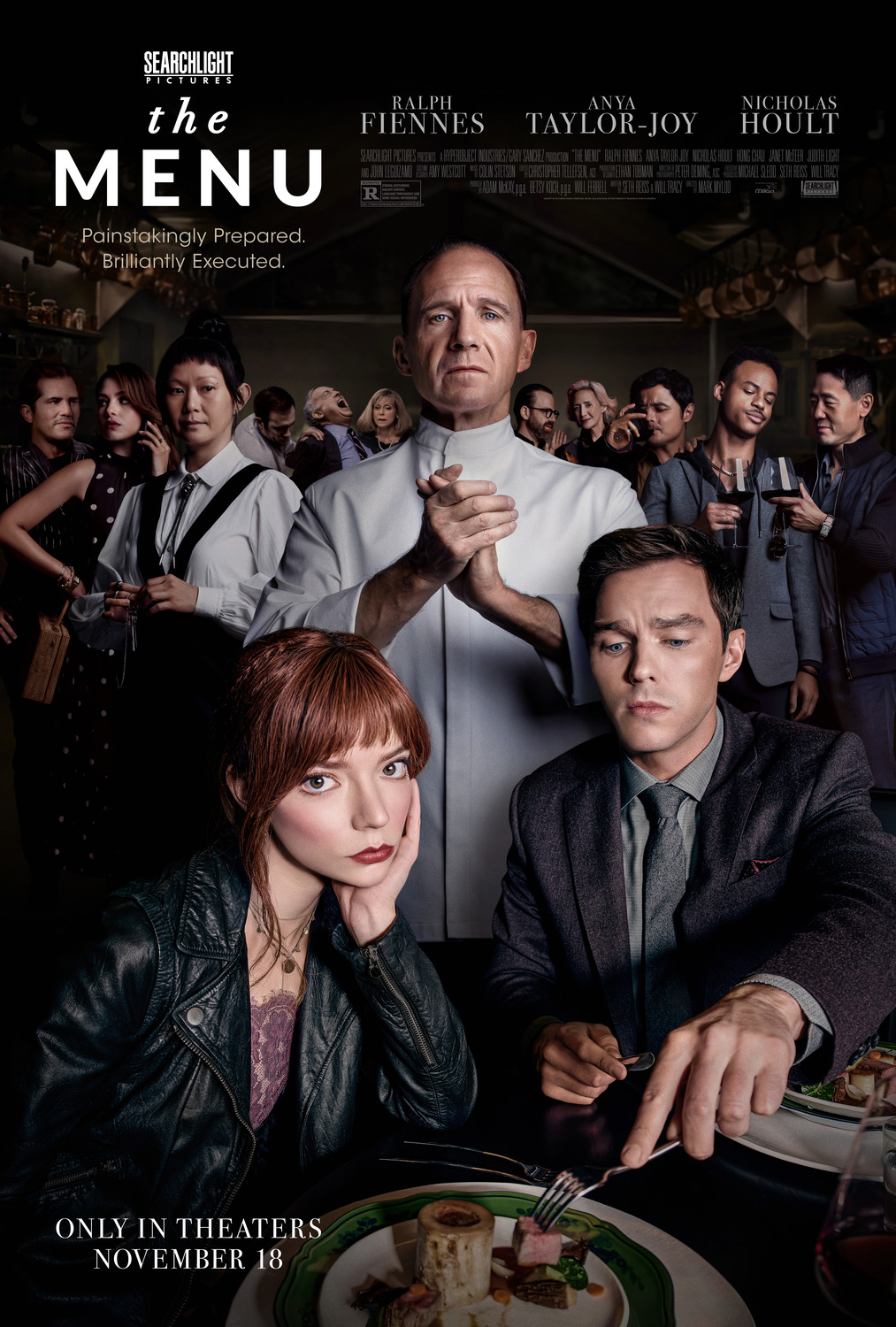
being targeted ends up being two-fold: The chef, and the customer. On the
chef’s part, Fiennes plays the role with a lot of Gordon Ramsay energy, right
down to actually calling a customer "donkey" at one point, but with
an added dash of Hannibal Lector darkness to bring out his self-admitted
monstrousness. He runs his kitchen like a charismatic cult leader, asking for
and getting absolute devotion from his staff, and every evening’s worth of food
is served like clockwork. Like a ritual. But in turning what he considers his
art into something so routine, so mundane, there’s no joy in it for him
anymore. Which kinda defeats the purpose of this whole endeavour, since high cuisine
is meant to elevate the simple act of consuming food out of necessity into
something of true enjoyment; an experience worth remembering beyond digestion.
And where’s the joy in something that has become so soulless?
To that
end, we have the customers… and it’s here where the satire gets really
juicy. There’s a lot of class warfare by way of food going on here, from Reed
Birney and Judith Light as a couple who eat at Hawthorne so regularly that
there’s no sense of occasion to it, Arturo Castro, Rob Yang, and Mark St. Cyr
as three tech bros who are connected to the cold financial side of high cuisine as a
business, John Leguizamo as a washed-up actor… I mean he’s playing a
washed-up actor, who is basically there as part of a bid to bullshit his way
into a TV show, Janet McTeer as a food critic, and then there’s Nicholas Hoult as the resident foodie and
fanboy of chef Slowik. Hoult’s Tyler is basically the worst aspects of the pretentious
art critic combined with the worst aspects of the ‘consoomer’. Only caring about his own gratification, which largely comes out of fart-sniffing pontification rather than actually appreciating the food in question, while also showing rather sociopathic disregard for the how and why of its
creation and the environment it comes from. It’s only about the
experience, not what it took to make it a reality. Never before has it been
easier to sympathise with Anya Taylor-Joy, who shows up here as Tyler’s date.
And in the
midst of all that, the film takes a pretty hard stance against that sort of
culinary exclusivity, where everything is designed solely for those who care more about their image than their intake, and are also so
well-off that they don’t need to consider just how much they’re spending
on food they don’t even care about. It links up with a lot of what I liked
about Steven Knight’s Burnt and even the ending of Spencer in how it shows
that, yes, making food at this tier is its own artform, but you can get even
greater rewards by giving people something simple and even cheap that they will
actually appreciate. It’s the same mentality behind my own approach to cinema
as art, which is why I really don't like the elitist condescension that regularly gets thrown at mainstream popcorn cinema and superhero flicks especially, and
it’s part of the reason why I hold people like Steven Soderbergh in such high
regard: Art shouldn’t be reserved just for the super-rich and privileged.
As a darkly
comedic thriller with veins of horror aesthetic in how it shows
self-realisation through gruesome and subversive means, it works very
nicely and benefits from strong casting and solid visuals. Anya Taylor-Joy and
Ralph Fiennes work amazingly well together, as do Taylor-Joy and Hoult. But as
a treatise on the importance of the creators and the servers in the process of
exhibiting art, whatever form that art may take, a lot of what it says is quite
accurate and delivered at just the right tone so that its inherent
silliness is able to rest comfortably alongside the darker moments and even the
emotional parts. It’s a nice reminder not to let the stiffness of routine get
in the way of entertainment, whether you’re providing it or engaging with it.
Remember to tip your servers.